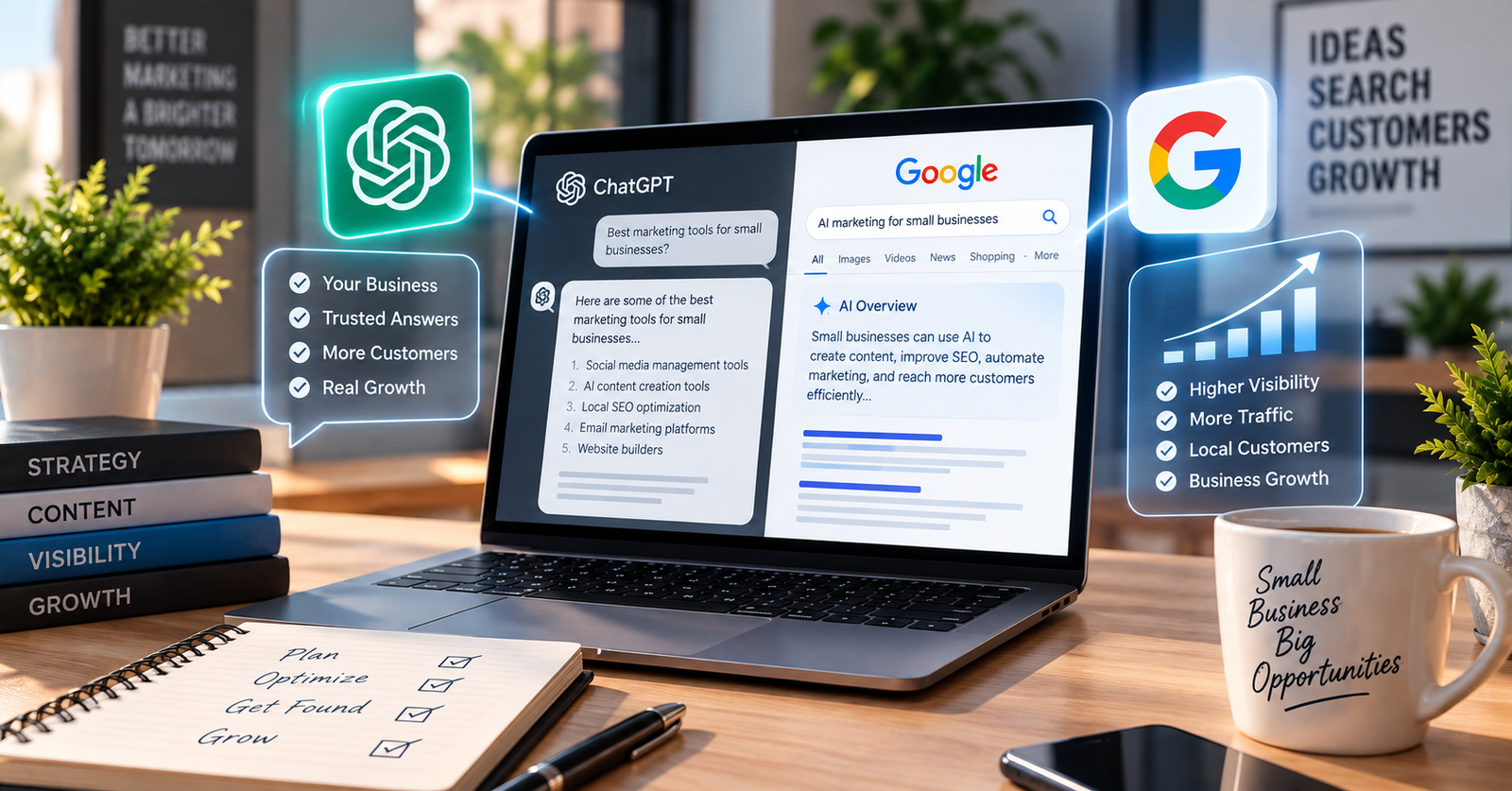
A customer looking for a plumber, boutique, or accountant used to type a few words into Google and follow the blue links. Now, when searching for a small business, they turn to ChatGPT, Claude, or Google AI Overview and ask a question. They expect an answer that includes a specific business recommendation.
This change means that small business SEO is no longer focused on landing on the first page of Google results. It is more important than ever to land first in an AI search. The businesses that understand this are adapting their SEO strategy now. As a result, Answer Engine Optimization is quickly becoming an important practice for any small business looking to appear in AI searches. Otherwise, even a strong Google SEO strategy may not keep a company visible in search results.
Why AI Search Behaves Differently Than Google Search
Traditional Google SEO is about keywords, backlinks, and on-page optimization. AI search optimization services are different because AI assistants like ChatGPT and Google AI Overviews don’t follow traditional search engine rules. Instead, training data and crawling activity matter more than the ranking factors that power traditional search engines.
Large language models such as GPT and Claude, as well as Google AI Overviews, analyze web pages. They use this analysis to build a profile of the business, its offerings, and its location. If an AI cannot find the information it needs, it will not cite that business as an example. For this reason, the ability to extract facts from a web page is critical for AI discoverability.
This is why AI search optimization is an entirely separate discipline. It focuses on making sure a website presents the right factual information in a way an AI can easily extract.
What Is AI Search Optimization? (And Why Google SEO Alone Isn’t Enough)
Four Steps For Small Businesses To Get Found in ChatGPT & Google AI
1. Put Facts in Text, Not Pictures
AI assistant crawlers cannot extract information from embedded images, files, or code. Therefore, important information such as hours of operation and costs should appear in body text on your website so that an AI knows what it is reading. Avoid hiding information in menus and modals.
2. Include FAQ Sections for Conversational AI
Create FAQ sections with questions and answers. This will help AI assistants understand what a customer might ask about your business, and it gives you more visibility in AI search results. Avoid using traditional SEO headers and titles. Instead, phrase the headings as questions, the way a customer would ask for assistance.
3. Make Sure AI Assistant Bots Can See Your Website
Three crawlers matter most, and each one feeds a different AI tool:
- GPTBot (OpenAI) — lets ChatGPT read and reference your content
- ClaudeBot (Anthropic) — lets Claude do the same
- Googlebot — Google’s standard search crawler, which also supplies the content behind Google’s AI Overviews, since Overviews pull from the regular Search index rather than a separate AI-only crawl
Check your robots.txt file and confirm you haven’t blocked any of these bots by accident. If your robots.txt file blocks one of them, that AI tool will skip your site entirely, even if your business ranks well in traditional Google search results.
4. Partner With Experts to Make Sure You Do Everything Right
Reviewing a website’s crawler access and making adjustments is time-consuming and requires technical knowledge. Many small business owners do not have the time or expertise to perform a technical SEO audit. For this reason, working with an outside agency that provides AI search optimization services can make the process much faster and more efficient.
They will find issues such as missing crawler access, poor information presentation, or low-quality content that hurts a business’s visibility in AI search results.
How Might an AI Assistant Find Your Business?
A customer asks ChatGPT, “Can you recommend a good boutique for a gift in Austin?” ChatGPT does not search the web for this query. Instead, it uses information it already knows and examples it has seen in past content.
To find a suitable boutique, it looks for web pages that contain specific factual information about what the boutique offers and where it is located. ChatGPT will cite a page that contains specific, detailed information discussing the offerings and location. It will favor a page that has an FAQ section and mentions reviews. However, it will not choose a page with vague blurbs about the boutique’s offerings and no specific location information.
This is why small business SEO is changing. A new type of optimization helps websites appear in AI search results. ChatGPT and similar assistants analyze web pages and extract facts from them, then use this information to decide which businesses to recommend. Because of this, a small business must optimize its website so that an AI assistant can crawl it.
Conclusion
Customers are shifting from typing keywords to asking questions, and AI assistants are becoming the new front door to local business. Small businesses that structure their content clearly, build real FAQ sections, and confirm AI crawlers can access their site put themselves in a strong position to be recommended.
A quick review of your content structure, FAQs, and crawler access can reveal exactly where you’re losing visibility, and where the right AI search optimization services could close the gap.
Frequently Asked Questions
1. What is AI search optimization?
AI search optimization is the process of optimizing your website to make it easier for an AI chatbot like ChatGPT, Claude, or Google AI to read, understand, and quote your content when answering a customer’s question.
2. How is AI search optimization different from SEO?
SEO focuses on improving your page ranking and visibility within search engine results. AI search optimization, on the other hand, focuses on improving text readability and quotability for large language models. In other words, search engines display websites, but AI chatbots deliver information directly to the user.
3. Which AI crawlers should I let scan my website?
Three crawlers matter most: GPTBot (OpenAI) lets ChatGPT reference your content, ClaudeBot (Anthropic) does the same for Claude, and Googlebot, Google’s standard search crawler, also supplies the content behind Google’s AI Overviews. Check your robots.txt file to confirm you haven’t blocked any of them. A blanket “deny all” rule will make your content invisible to whichever tool that bot powers.
4. How quickly will I see improvements after implementing AI search optimization services?
You should begin to see crawlers indexing updated web pages within a few weeks of implementing changes. However, the speed with which these optimizations take effect depends on how much material you had to optimize and how competitive your space is.
5. Do I need to hire an AI search optimization service, or can I do it myself?
If you only need to make minor adjustments, such as adding information or updating your FAQ section, you may be able to implement these changes in-house. However, if you need a comprehensive analysis of what changes should be made at the infrastructural level, an experienced team should handle it.
Firestarter builds and optimizes websites that AI tools like ChatGPT and Google AI can actually find, read, and cite. Get in touch for a free AI-readiness audit and see exactly where your site stands today.
[Request Your Free AI Readiness Audit]